What Your Sleep Schedule Is Actually Telling You
You set the alarm for 6am. It goes off. You silence it and lie there, staring at the ceiling, willing your body to cooperate. Meanwhile, somewhere across town, your colleague has already been awake for an hour, exercised, and is halfway through their morning coffee before the sun has fully risen.
This is not a matter of discipline. It is not about who wants success more, or who is more productive, or who has better habits. It is biology. Specifically, it is chronobiology — the study of how your internal clock governs every system in your body, including when you sleep and when you wake.
Your chronotype is the expression of that internal clock. It is the natural timing of your sleep window, your peak alertness, your energy troughs, and your recovery period. And unlike a preference you can simply decide to change, your chronotype is largely written in your DNA.
The Four Chronotypes: Lion, Bear, Wolf, and Dolphin
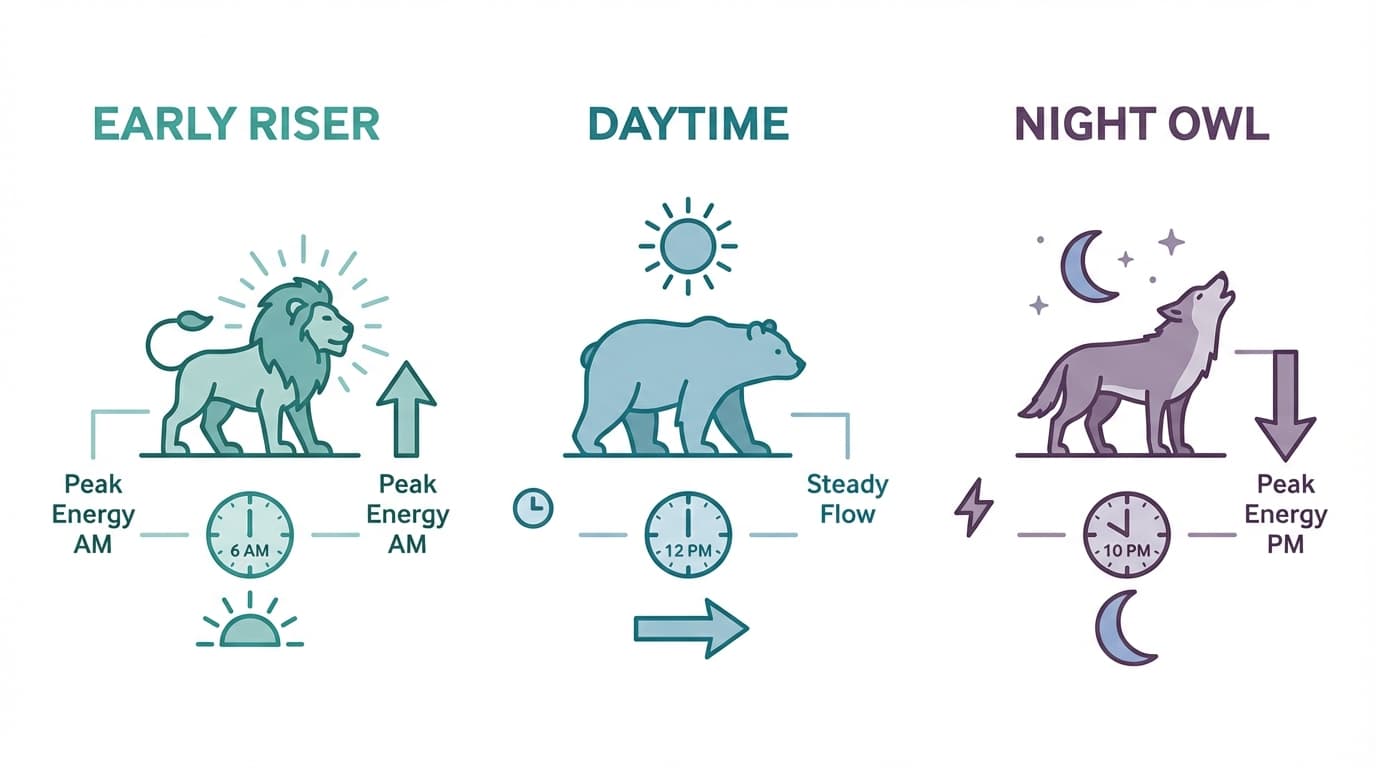
Sleep researcher Dr. Michael Breus popularised a four-category framework for chronotypes that moves beyond the old morning person vs night owl binary. Each category reflects a distinct biological sleep window and energy rhythm.
- Lion: Natural wake time around 5-6am, peak performance from 8am to noon, energy declining sharply in the afternoon
- Bear: Natural wake time around 7am, follows the solar cycle, peaks mid-morning, experiences a noticeable post-lunch dip
- Wolf: Natural wake time around 9am or later, slow to warm up in the morning, peaks creatively and mentally in the evening
- Dolphin: Light sleeper with irregular sleep patterns, prone to waking during the night, often most alert mid-morning and then again in the late evening
Most people fall into the Bear category — roughly 55% of the population. Lions account for about 15%, wolves another 15-20%, and dolphins the remaining 10-15%. These are not equal distributions, which is part of why society's 9-to-5 schedule works reasonably well for the majority while quietly exhausting the rest.
Why Fighting Your Chronotype Makes You Tired
Every cell in your body has a biological clock. These clocks are coordinated by a master pacemaker in the brain called the suprachiasmatic nucleus, which responds to light and sets the timing for sleep pressure, cortisol release, body temperature, and dozens of other physiological processes.
When you consistently wake up outside your natural window — either too early or too late — you create what chronobiologists call social jetlag. Your social schedule and your biological schedule are out of phase. The result is a kind of chronic fatigue that no amount of coffee fully fixes.
- A wolf forced to wake at 6am for an 8am office start is, biologically speaking, waking in the middle of their night
- A lion who stays up late for social events is borrowing sleep time they will never fully recover
- A dolphin who tries to sleep 8 hours straight through the night often fragments their sleep further by fighting their natural light-sleeping tendency
Research by Till Roenneberg at Ludwig Maximilian University in Munich found that people with late chronotypes who are forced into early schedules show measurable increases in depression, obesity, cardiovascular disease, and metabolic syndrome. The mechanism is hormonal: when sleep timing is wrong, cortisol, insulin, and melatonin all release at the wrong times relative to food intake and activity.
The Genetics of Sleep Timing
Your chronotype is not fully fixed for life — it shifts with age. Children tend to be early risers, teenagers shift strongly toward later sleep phases (this is real biology, not teenage laziness), and adults gradually shift back toward earlier times as they age. But within any age group, there is substantial genetic variation.
Several genes influence chronotype, including PER3, CLOCK, and CRY1. A variant of the CRY1 gene, for instance, has been linked to delayed sleep phase disorder — an extreme form of late chronotype where the biological night starts hours later than average. Studies of identical twins show that chronotype is roughly 50% heritable, meaning environment matters, but biology provides a strong baseline.
- Exposure to natural light in the morning can shift your clock earlier by 30-60 minutes over time
- Artificial light exposure at night pushes the clock later, often significantly
- Consistent sleep and wake times train your circadian rhythm to be more predictable
But within these adjustable parameters, there is a biological set point that is genuinely difficult to override — and consistently trying to do so has real health costs.
How to Identify Your Chronotype
The simplest self-assessment: on a day with no obligations, no alarm, and no social pressure, what time do you naturally wake up and feel alert? What time does your energy peak? When does your focus sharpen?
The Munich Chronotype Questionnaire (MCTQ) is a validated research tool that calculates your midpoint of sleep on free days as a measure of your underlying chronotype. Informally, you can ask yourself:
- On a completely free day, what time would you wake up feeling rested?
- When does your thinking feel sharpest — before noon, mid-afternoon, or evening?
- How long does it take you to feel fully alert after waking?
- Do you struggle to fall asleep before midnight, or do you find yourself yawning at 9pm?
A lion wakes easily and early, feels sharp immediately, and is often in bed by 9:30 or 10pm. A wolf struggles to get going before 10am, feels most creative after dinner, and naturally falls asleep after midnight. A bear follows the sun. A dolphin sleeps lightly, wakes frequently, and never quite feels fully rested.
Working With Your Chronotype Instead of Against It
The practical goal is not to change your chronotype but to build your schedule around it wherever possible. This means protecting your peak alertness window for your most cognitively demanding work, placing administrative or routine tasks in your energy troughs, and aligning your social schedule with your natural wind-down period.
- Lions: Deep work in the morning, decision-making before noon, avoid scheduling important meetings after 3pm
- Bears: Tackle complex tasks mid-morning, use the post-lunch dip for admin, prioritise evening wind-down routines
- Wolves: Do not fight the slow morning — use it for low-stakes tasks, protect the 6-9pm window for creative or analytical work
- Dolphins: Short focused work blocks throughout the day, avoid caffeine after noon, prioritise sleep environment to reduce fragmented sleep
The Sleep Archetype programme is built around this principle. Your chronotype is not a personality quirk to manage — it is a biological reality to accommodate. Understanding yours is the first step toward sleeping better, feeling more alert, and making better decisions at the times your brain is actually built for.
What Happens When You Get It Right
People who align their schedules with their chronotype report substantial improvements in mood, cognitive performance, and physical energy — often within days, not weeks. This is not a placebo effect. It is your hormonal system finally firing in the right sequence at the right time.
Cortisol rises when it should. Melatonin releases when it should. Your body temperature follows its proper curve. The result is a sleep-wake cycle that feels natural rather than forced — because it finally is.
Your chronotype is not something to fix. It is something to understand.
Discover Your Sleep Chronotype
Take our free quiz to find your unique sleep chronotype and get a personalized 8-week program to optimize your sleep and energy.
Take the Free Quiz →More Articles
Social Jetlag: Why Your Weekend Sleep Habits Are Ruining Your Monday
Social jetlag disrupts your circadian rhythm every weekend. Learn how inconsistent sleep timing affects metabolism, mood, and long-term health by chronotype.
The Best Time to Nap Based on Your Chronotype
Discover the best time to nap based on your chronotype. Learn how Lions, Bears, Wolves, and Dolphins should time 20 vs 90-minute naps for maximum alertness.
How Much Sleep Do You Actually Need? (It Depends on Your Chronotype)
Discover how much sleep you actually need based on your chronotype. Bears, lions, wolves, and dolphins each have different optimal sleep durations.