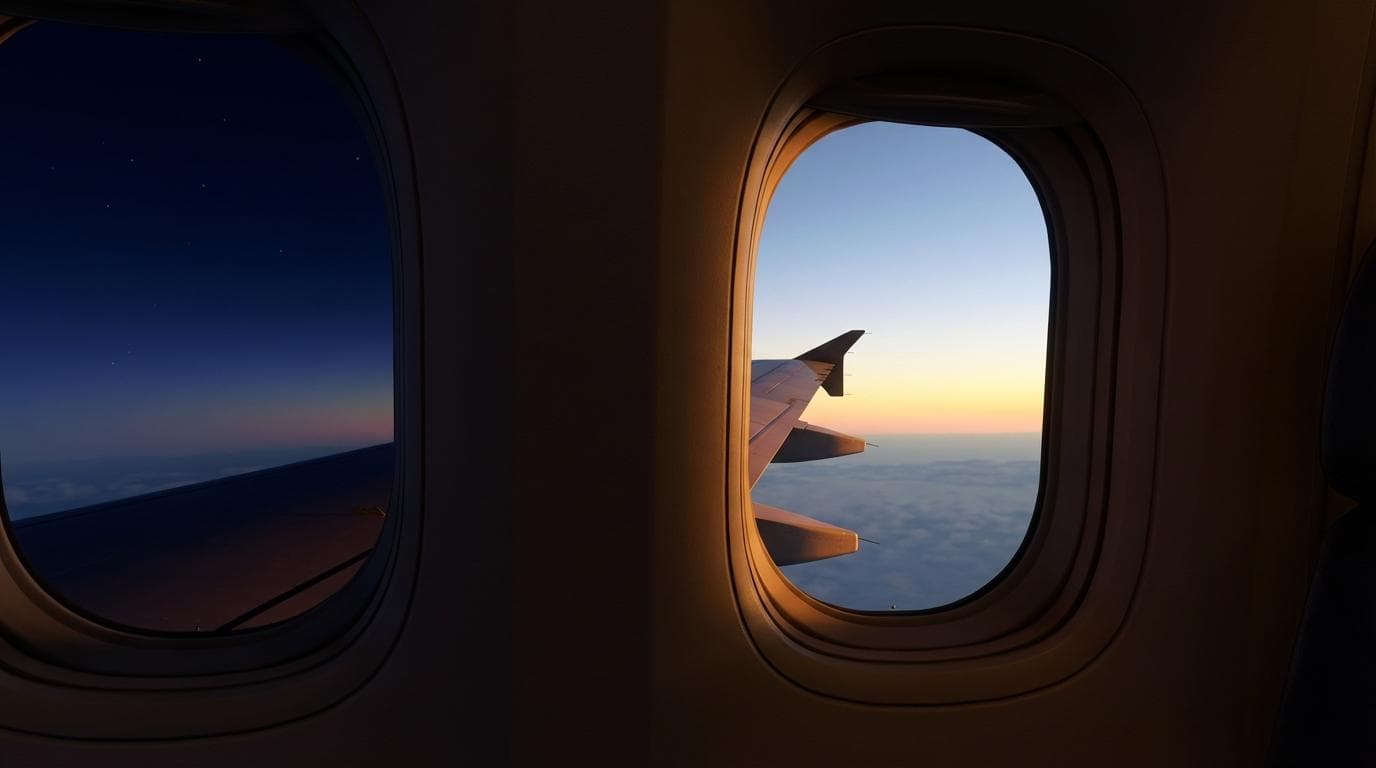
Jet lag is one of the few sleep disruptions that almost everyone understands intuitively — your body thinks it's 3 AM but the local clock says noon, and nothing about your energy, digestion, or mental clarity cooperates. What most people don't realize is that how quickly you recover from jet lag depends significantly on your chronotype, the direction you traveled, and the specific strategies you use in the first 48 hours.
Why Jet Lag Happens
Your circadian rhythm — the internal 24-hour clock that governs sleep, alertness, hormone release, and body temperature — is synchronized primarily by light exposure. When you cross time zones rapidly, your circadian clock remains locked to your departure time zone while local cues (daylight, meal times, social schedules) demand a different rhythm.
The result is a mismatch between your internal biology and external environment. Your body is releasing melatonin when you should be awake. Your cortisol peaks at the wrong time. Your digestive system expects food when you should be sleeping.
This mismatch takes time to resolve because the circadian clock can only shift by approximately 1-1.5 hours per day under normal conditions. Cross 6 time zones, and you're looking at roughly 4-6 days of adjustment without intervention.
Eastward vs. Westward Travel
The direction of travel matters significantly. Traveling east is harder on the body than traveling west for most people.
When you fly west, you're extending your day — staying awake longer than usual. Since most people's internal clocks run slightly longer than 24 hours naturally, westward travel aligns with this tendency. You feel tired earlier than local bedtime but can generally push through.
Eastward travel requires advancing your clock — going to bed and waking up earlier than your body expects. This works against the natural tendency of the circadian clock and is why flying from the US to Europe typically produces more severe jet lag than the return trip.
How Your Chronotype Affects Jet Lag Recovery
This is where things get interesting and personalized. Your chronotype determines your baseline circadian flexibility, which directly impacts how well you handle time zone shifts.
Lions (early chronotype) tend to recover faster from westward travel because their advanced circadian phase makes it easier to shift earlier. However, Lions often struggle more with eastward travel than expected — their already-early clock has less room to advance further. Recovery tip for Lions: on eastward trips, use bright light exposure immediately upon waking to pull your clock forward. Avoid your instinct to go to bed extremely early on arrival — push to at least 9 PM local time.
Bears (intermediate chronotype) have the most flexible circadian systems and generally recover from jet lag faster than other chronotypes in either direction. Bears should focus on light exposure timing and meal scheduling — their adaptable clocks respond well to these cues. Recovery time: roughly 1 day per time zone crossed.
Wolves (late chronotype) actually have an advantage with eastward travel that surprises many people. Because Wolves naturally run late, advancing their clock to match an earlier time zone is sometimes easier than expected — they're simply being forced into the schedule the rest of the world already operates on. Westward travel can be trickier for Wolves, as it pushes their already-late clock even later. Recovery tip for Wolves: use morning light aggressively and avoid screens after sunset in the new time zone.
Dolphins (irregular chronotype) tend to have the hardest time with jet lag because their circadian rhythms are already fragile. Any disruption — including time zone changes — can cascade into several nights of poor sleep. Dolphins should plan the most aggressively for jet lag, starting circadian adjustments before departure. Recovery tip for Dolphins: consider melatonin supplementation (0.5-1mg) timed to the destination bedtime, starting 2-3 days before travel.
Science-Backed Strategies for Faster Recovery
Strategic Light Exposure
Light is the single most powerful tool for resetting your circadian clock. The key is timing.
For eastward travel: seek bright light in the morning at your destination. Natural sunlight is ideal — even 30 minutes outdoors without sunglasses can significantly accelerate clock adjustment. Avoid bright light in the evening.
For westward travel: seek bright light in the late afternoon and evening at your destination. Avoid morning light for the first day or two if possible, or wear sunglasses during morning outdoor time.
The worst thing you can do is get light exposure at the wrong time, which can shift your clock in the wrong direction and actually worsen jet lag. A simple rule: for eastward travel, morning light; for westward travel, evening light.
Meal Timing
Your digestive system has its own circadian clock, and meal timing is a powerful secondary synchronizer. Eating meals at local meal times — even if you're not hungry — signals to your body that it should be awake and active.
Conversely, fasting during the flight (particularly on overnight flights) and then eating breakfast at the destination's breakfast time can help accelerate the reset. Some research suggests that a 16-hour fast before arrival may help the body's food-entrainable clock override the light-entrainable clock temporarily.
Strategic Melatonin Use
Melatonin is not a sleeping pill — it's a clock-setting signal. Taking a low dose (0.5-3mg) at the target bedtime in your new time zone can help advance or delay your circadian clock.
For eastward travel: take melatonin at bedtime in the new time zone (which will feel early to your body) for 3-4 nights after arrival.
For westward travel: melatonin is generally less useful, as your body naturally wants to delay. If you're waking too early, a very small dose in the middle of the night may help.
Pre-Departure Adjustment
The most effective jet lag strategy starts before you leave. Shifting your sleep schedule by 30-60 minutes per day in the direction of your destination for 3-4 days before departure can cut recovery time in half.
For Lions and Bears, this is relatively straightforward. For Wolves, pre-departure adjustment for eastward travel means going to bed progressively earlier — which may require dimming lights and avoiding screens earlier than usual. For Dolphins, this pre-adjustment period is especially valuable because it prevents the abrupt disruption that tends to destabilize their already sensitive sleep patterns.
What Doesn't Work
Sleeping pills on the flight: These may help you sleep on the plane, but they don't reset your circadian clock. You arrive rested but still jet-lagged.
Caffeine as a substitute for sleep: Coffee can mask fatigue but doesn't address the underlying circadian misalignment. Use caffeine strategically — in the morning at your destination — rather than continuously.
Forcing yourself to stay awake all day upon arrival: This is popular advice but counterproductive if taken to extremes. A short nap (under 30 minutes) in the early afternoon is fine and can prevent the extreme fatigue that leads to falling asleep at 6 PM and waking at 2 AM.
The Chronotype Advantage
Understanding your chronotype gives you a significant advantage in jet lag recovery because it tells you your starting point. A Wolf trying the same recovery protocol as a Lion will get different results — not because the protocol is wrong, but because their circadian clocks have different baseline positions and different degrees of flexibility.
Take the free chronotype quiz to discover your sleep archetype and learn exactly how your body clock works — including how to handle disruptions like jet lag, shift changes, and seasonal time adjustments.
Further Reading
Discover Your Sleep Chronotype
Take our free quiz to find your unique sleep chronotype and get a personalized 8-week program to optimize your sleep and energy.
Take the Free Quiz →More Articles
Social Jetlag: Why Your Weekend Sleep Habits Are Ruining Your Monday
Social jetlag disrupts your circadian rhythm every weekend. Learn how inconsistent sleep timing affects metabolism, mood, and long-term health by chronotype.
The Best Time to Nap Based on Your Chronotype
Discover the best time to nap based on your chronotype. Learn how Lions, Bears, Wolves, and Dolphins should time 20 vs 90-minute naps for maximum alertness.
How Much Sleep Do You Actually Need? (It Depends on Your Chronotype)
Discover how much sleep you actually need based on your chronotype. Bears, lions, wolves, and dolphins each have different optimal sleep durations.