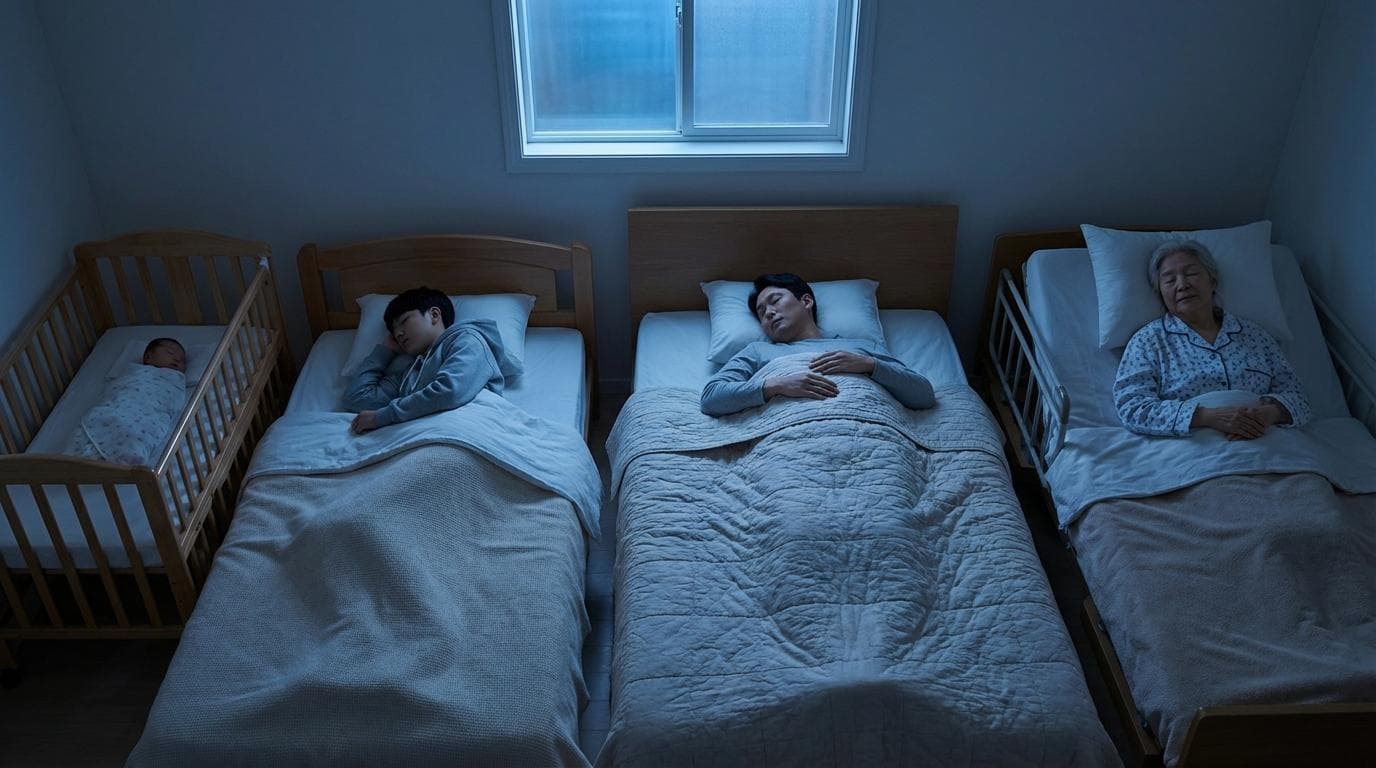
How much sleep do you actually need? It sounds like a simple question, and you have probably heard the answer before: eight hours. But that number hides enormous variation. The research on sleep requirements shows that the ideal amount changes significantly across the human lifespan, differs between individuals, and depends on factors that go well beyond a single nightly target.
Sleep by Age: What the Research Actually Shows
The most comprehensive guidance on sleep requirements comes from the American Academy of Sleep Medicine and the Sleep Research Society, whose consensus recommendations cover the full human lifespan. These are not arbitrary targets. They reflect decades of research linking sleep duration to health outcomes including cognitive function, immune response, cardiovascular health, metabolic regulation, and mortality risk.
Newborns (0-3 months) need the most sleep of any life stage: 14 to 17 hours in every 24-hour period. This sleep is not continuous — newborns cycle through sleep and wakefulness every few hours — but the total need is enormous because sleep is driving the rapid neural development happening in those first weeks.
Infants (4-11 months) typically need 12 to 15 hours. As feeding patterns stabilize and the circadian system begins to develop, nighttime sleep consolidates and daytime sleep consolidates into predictable naps.
Toddlers (1-2 years) generally require 11 to 14 hours, while preschool-aged children (3-5 years) need 10 to 13 hours. For children in these ranges, adequate sleep is directly tied to behavioral regulation, language development, and emotional stability. Sleep-deprived toddlers do not look sleepy — they often look hyperactive.
School-age children (6-12 years) need 9 to 12 hours, a range that many children in developed countries consistently fail to meet. Early school start times, evening screen use, and busy after-school schedules are common culprits.
Teenagers (13-18 years) require 8 to 10 hours, but their biology works against them. Adolescence brings a genuine circadian phase delay — the internal clock shifts later, making it physiologically difficult to fall asleep before 11pm or midnight. When schools start at 7am or 7:30am, chronic sleep restriction is essentially built into the schedule.
Adults (18-64 years) are typically advised to get 7 to 9 hours. This is the most studied range, and the evidence is clear that consistently getting fewer than 7 hours per night is associated with measurably worse outcomes across nearly every health domain.
Adults 65 and older generally need 7 to 8 hours, though the character of sleep changes with age. Deep slow-wave sleep decreases, sleep becomes more fragmented, and waking earlier in the morning is common. Some of these changes reflect normal aging; others can indicate treatable sleep disorders.
How Much Sleep Do I Need? Individual Variation Within the Ranges
The ranges above describe population-level needs, but you are not a population. Within any age group, genuine individual variation exists. Some people function optimally at the low end of the recommended range; others need to be at the high end. A very small percentage — genetics researchers estimate around 3% — carry variants in genes like DEC2 and ADRB1 that allow them to function well on 6 hours or less with no apparent health consequences. These short sleepers are not the same as people who have simply habituated to running a sleep debt.
The difficulty is that humans are notoriously poor at assessing their own sleep deprivation. Laboratory studies consistently show that people who have been sleep-restricted for two weeks report feeling fine while their cognitive performance measures continue to decline. This is called adaptation to impairment, and it means you cannot reliably use how you feel to determine whether you are getting enough sleep.
More reliable indicators include: falling asleep within minutes of your head hitting the pillow (sign of sleep pressure accumulation), requiring an alarm to wake up at your target time (sign that your body has not yet completed its sleep need), and relying on caffeine to function in the morning (sign of ongoing sleep debt).
Your Chronotype and Sleep Requirements
How much sleep you need and when you naturally need it are related but distinct questions. Your chronotype — whether you are a lion, bear, wolf, or dolphin — determines the timing of your optimal sleep window, but it does not change the total amount your brain and body require.
Lion chronotypes wake naturally early and feel their sharpest in the morning. Their sleep window typically falls between 10pm and 6am. Bears, the most common chronotype, track roughly with the solar cycle and tend toward 11pm-7am. Wolves come alive in the evening and feel most alert in the late afternoon and night, with their natural sleep window running from midnight to 8am or later. Dolphins are light, fragmented sleepers who wake easily and rarely feel fully rested.
The bear chronotype is most closely aligned with conventional social schedules, which is one reason bears often sleep the recommended 7-9 hours without needing to deliberately engineer their environment. Wolves face chronic social jet lag — the mismatch between their biological clock and their required schedule — which can mean they are technically in bed for 7-8 hours but not getting restorative sleep across all stages because the timing is wrong for their biology.
Dolphins, meanwhile, are not chronotype in the strict sense — they are more often characterized by hyperarousal of the nervous system, light sleep architecture, and a tendency toward anxiety-related wakefulness. For dolphins, getting the recommended amount of sleep often requires more deliberate intervention than it does for other types.
Sleep Requirements Across Life Stages: A Practical Framework
The numbers matter less than what they represent. What you are trying to achieve with your sleep is adequate time to complete the sleep cycles your brain and body run through each night. A typical full night includes 4-6 complete cycles of approximately 90 minutes each, moving through light sleep, deep slow-wave sleep, and REM sleep. Different stages serve different functions: slow-wave sleep is critical for physical restoration, immune function, and memory consolidation; REM sleep is essential for emotional processing, creativity, and complex learning.
When you cut sleep short — even by an hour — you disproportionately cut REM sleep, because REM cycles lengthen toward morning. This is one reason that the difference between 6 and 8 hours of sleep is not simply 2 fewer hours of rest. It is significantly less time in the stages of sleep that handle the most cognitively and emotionally demanding work.
For children and teenagers, missing sleep stages during critical developmental windows can have effects that are difficult to reverse. The brain's pruning and myelination processes, much of which occurs during sleep, shape the neural architecture that will persist into adulthood.
Practical Guidance: Finding Your Personal Sleep Need
The most reliable way to determine your individual sleep need is to observe yourself across 2-3 weeks of schedule freedom — a vacation or an extended break where you can go to sleep when you feel sleepy and wake up without an alarm. Most people will initially sleep longer as they recover from accumulated debt, then settle into a consistent pattern. The duration you naturally gravitate to once the debt is paid is a reasonable approximation of your actual sleep need.
If you find you consistently need more sleep than you are getting in your normal life, the answer is not to habituate to the shortfall. It is to prioritize the conditions that make getting enough sleep possible — consistent sleep and wake times, a cool and dark sleep environment, and a wind-down period that allows your nervous system to disengage from the demands of the day.
Take our free Sleep Archetype Quiz to find your chronotype and get a personalized plan for meeting your sleep needs.
Further Reading
Discover Your Sleep Chronotype
Take our free quiz to find your unique sleep chronotype and get a personalized 8-week program to optimize your sleep and energy.
Take the Free Quiz →More Articles
Social Jetlag: Why Your Weekend Sleep Habits Are Ruining Your Monday
Social jetlag disrupts your circadian rhythm every weekend. Learn how inconsistent sleep timing affects metabolism, mood, and long-term health by chronotype.
The Best Time to Nap Based on Your Chronotype
Discover the best time to nap based on your chronotype. Learn how Lions, Bears, Wolves, and Dolphins should time 20 vs 90-minute naps for maximum alertness.
How Much Sleep Do You Actually Need? (It Depends on Your Chronotype)
Discover how much sleep you actually need based on your chronotype. Bears, lions, wolves, and dolphins each have different optimal sleep durations.