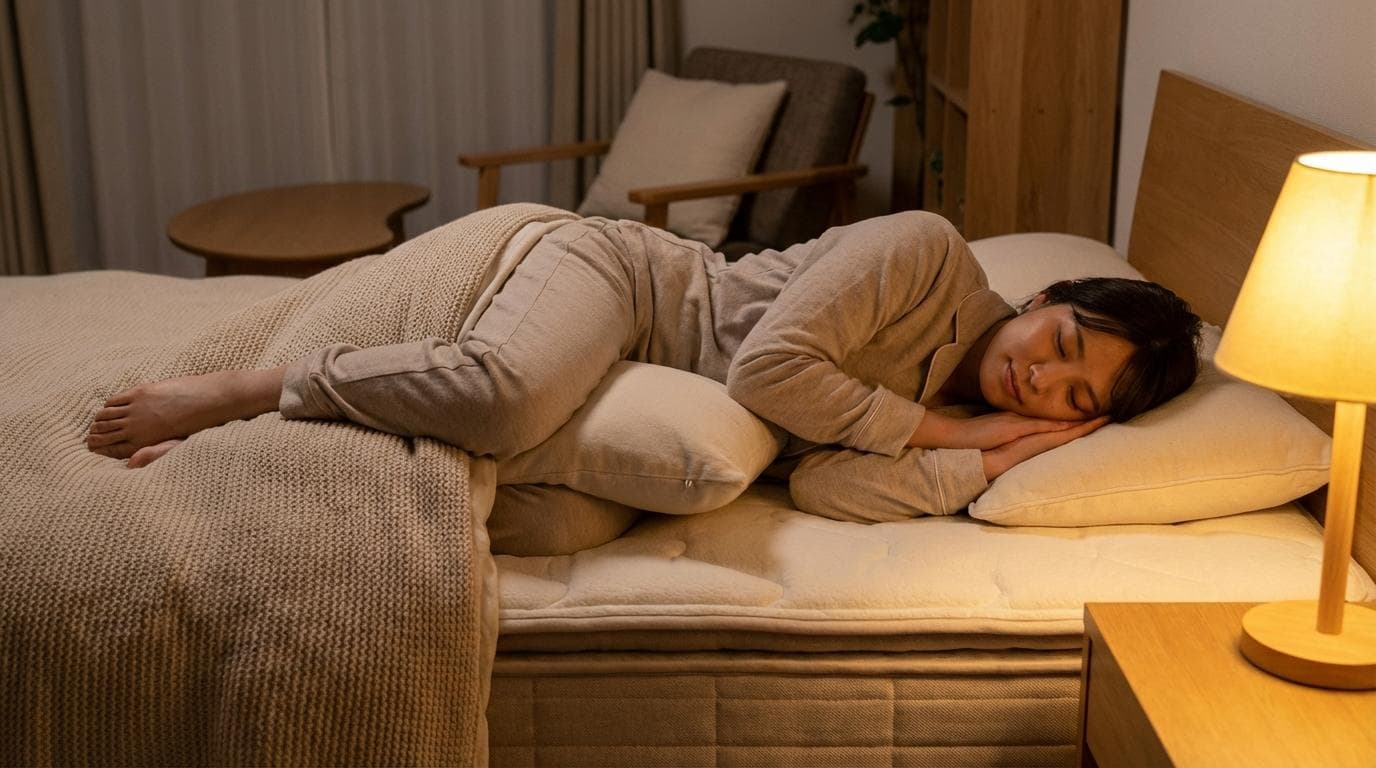
Back pain and sleep have a complicated relationship. Poor sleep worsens pain perception. Pain disrupts sleep quality. And the position you sleep in can either relieve the strain on your spine or compound it significantly over the course of a night.
If you wake up with a stiff lower back, aching hips, or tension between your shoulder blades, your sleep position is almost certainly a contributing factor. The good news: strategic adjustments — often involving just a pillow placed in a specific spot — can make a meaningful difference without requiring a new mattress or a visit to a specialist.
Sleep Position and Its Impact on Back Pain
When you lie down, your spine needs to maintain something close to its natural alignment: a slight inward curve at the lumbar region (lower back), and a corresponding curve at the neck. When sleep positions force the spine out of this alignment for hours at a time, the muscles, ligaments, and discs that support it are placed under sustained, low-grade stress. Over the course of a night, that stress adds up.
The challenge is that the ideal sleep position for back pain depends on where the pain is, what's causing it, and your body's natural geometry — factors that vary considerably from person to person. However, the research offers some useful general guidance that applies to most people with non-specific lower back pain.
Best Sleeping Position for Most Back Pain Sufferers
For most people with general lower back pain, sleeping on the back with a pillow under the knees is the most consistently supported position. This posture accomplishes several things at once: it distributes your weight across the widest surface area of your body, reduces pressure on any single point, and — critically — elevates the knees slightly, which flattens the lumbar curve and reduces tension in the lower back muscles and hip flexors.
The addition of the knee pillow is what makes this position effective. Without it, lying flat on the back can actually increase lumbar curve for people with tight hip flexors, which aggravates rather than relieves lower back pain.
If you sleep on your back and wake with back pain, try this before assuming the position itself is the problem: place a firm pillow (or rolled-up blanket) under your knees and assess whether the outcome changes over a week. For many people, this single adjustment is sufficient.
Back Pain Sleep Solutions for Side Sleepers
Side sleeping is the most common sleep position, and it's generally considered second-best for back pain management — with important caveats.
The primary issue with side sleeping is pelvic drop: without support, the top hip falls forward and downward toward the mattress, rotating the lumbar spine and creating asymmetrical tension throughout the lower back and sacroiliac joint. The correction is simple: a pillow between the knees.
Placing a pillow between your knees when sleeping on your side keeps your hips stacked, your pelvis level, and your lumbar spine in a neutral position. This single adjustment resolves the majority of side-sleeping-related back pain.
If you have hip pain or pressure at the shoulder that touches the mattress, a softer mattress or a body pillow (which supports both the upper arm and upper knee simultaneously) may also help.
For people with specific conditions: those with lumbar disc problems or sciatica often find that sleeping on the side of the leg that has less pain, with a pillow between the knees, provides the most relief. Those with spinal stenosis — a narrowing of the spinal canal that creates nerve pressure — frequently find that a slightly curled fetal position on the side reduces symptoms, as flexing the spine opens the spinal canal slightly.
What to Avoid: Stomach Sleeping and Back Pain
Stomach sleeping is consistently associated with worse outcomes for back pain, and the reasons are mechanical. In this position, the lumbar spine is hyperextended (curved excessively downward), and the head is turned to one side for the entire night, creating sustained rotation in the cervical spine.
If you're a committed stomach sleeper, making an immediate switch to a different position is difficult — most people have some degree of habit and preference in how they fall asleep. However, a pillow placed under the pelvis (hips, not abdomen) can significantly reduce lumbar hyperextension and is a more realistic first step than attempting to abandon the position entirely.
Over time, if stomach sleeping is contributing significantly to your back pain, gradual repositioning — starting on your side and allowing yourself to roll — is generally more successful than trying to change the position at the moment of sleep onset.
The Mattress Factor in Back Pain Sleep
Sleep position matters, but so does the surface you're sleeping on. A mattress that's too soft allows the heaviest parts of your body — hips and shoulders — to sink too deeply, creating a hammock effect that rounds the lumbar spine. A mattress that's too firm creates pressure points at the hips and shoulders, preventing neutral alignment.
The research on mattress firmness and back pain suggests that medium-firm mattresses outperform both extremes for most people with chronic lower back pain. However, individual body geometry matters: side sleepers with wide hips relative to their waist may need more give than back sleepers of similar weight.
If your mattress is a contributing factor, a mattress topper can be a cost-effective way to adjust firmness before committing to a replacement.
Best Sleeping Position by Chronotype
Your chronotype affects not just when you sleep but how deeply and in what phases. Bear chronotypes — who represent the majority of the population — tend to have relatively balanced sleep architecture and are often more adaptable to position changes than extreme types.
Light sleepers, including many Dolphin chronotypes, frequently have elevated sleep-time muscle tension and are more sensitive to position-related discomfort. For Dolphins in particular, the back-sleeping position with knee support and a slightly elevated head (10-15 degrees) often works better than side sleeping, which can increase arousal from discomfort mid-cycle.
Night owls and Wolf chronotypes, who tend toward deeper REM sleep cycles in the second half of the night, may find that lower back pain is worse in the morning precisely because their longest, deepest sleep phases occur when they've been in the same position for the most extended periods. Paying attention to starting position and having a secondary comfort position ready to transition into if they wake at night can help.
Morning Lions, who typically wake early and whose deepest sleep occurs in the first half of the night, often report less position-related discomfort overall — though their early rising means they may be spending time in positions that need to be evaluated over a shorter total window.
Transitional Positions and Night Movement
Most people change positions 3-8 times during the night, and this is generally protective — it prevents sustained pressure on any single area. If you find you're waking because you've settled into an uncomfortable position, the goal isn't to lock yourself into one posture, but to start well and have comfortable options to transition to.
Keeping a second pillow accessible, sleeping in the middle of the bed so you have room to shift, and using a body pillow that can be repositioned as you move are all practical ways to support comfortable transitions without consciously managing your position throughout the night.
When Sleep Position Isn't Enough
If back pain is severe, constant, or accompanied by symptoms like leg numbness or tingling, weakness in the legs, or any bladder or bowel changes, these warrant medical evaluation rather than positional adjustments alone. Sleep position modifications are an appropriate and often effective first step for non-specific musculoskeletal back pain; they are not a substitute for assessment of underlying structural issues.
For most people with garden-variety lower back pain, however, the research is clear that sleep position matters, specific modifications help, and the changes required are neither expensive nor complicated.
Take our free Sleep Archetype Quiz to find your chronotype and get a personalized sleep plan that accounts for your natural patterns.
Further Reading
Discover Your Sleep Chronotype
Take our free quiz to find your unique sleep chronotype and get a personalized 8-week program to optimize your sleep and energy.
Take the Free Quiz →More Articles
Social Jetlag: Why Your Weekend Sleep Habits Are Ruining Your Monday
Social jetlag disrupts your circadian rhythm every weekend. Learn how inconsistent sleep timing affects metabolism, mood, and long-term health by chronotype.
The Best Time to Nap Based on Your Chronotype
Discover the best time to nap based on your chronotype. Learn how Lions, Bears, Wolves, and Dolphins should time 20 vs 90-minute naps for maximum alertness.
How Much Sleep Do You Actually Need? (It Depends on Your Chronotype)
Discover how much sleep you actually need based on your chronotype. Bears, lions, wolves, and dolphins each have different optimal sleep durations.